

Identity vs Deviance: The origins of incompatible views of transness & the fight for trans rights
Social constructionism vs biological determinism explained

Some people support and embrace trans/nonbinary people and transness, even if they don’t really understand it. They support gender-affirming care and accept the scientific and medical evidence-based consensus that transition, affirmation, and support lead to better health outcomes and happier trans/nonbinary people.
I’m confident most of my readers fall into that description.
Others think trans/nonbinary people are delusional, ill, or deviant. They think of transness as pathological, as “gender ideology,” as something insidious to be eradicated. This point of view glared at me this week from the DefSec’s statement about Scouting America (as covered by Erin in the Morning). This week’s actions in Kansas to immediately invalidate trans people’s state IDs also springs from this place. It broke and continues to break my heart when it comes from my own family members.
Whenever I get trolls who clearly fall in this camp, I delete their comments and block them. Their minds and hearts are not open to listening to anything I have to say. I don’t have the time for that emotional labor and no patience for their vitriol.
Plenty of people are somewhere in the middle; not fully supportive, not actively ruining our lives. Nothing in society is ever a cut-and-dry binary, two buckets where you belong in either one or the other, A or B, 0 or 1. Even in biology, things are more fluid and spectrum-y. Though this essay discusses two approaches, imagine them as points on a spectrum, or even as areas floating in 3D space. (I tell my students, all models are wrong; some are useful.)
To understand how there can be such disparate approaches, we need to take a big step back into how we look at and understand the world, which lenses we have in our proverbial glasses. At everything, not just sex/gender.
But first, let me make this clear: though I’m discussing two different approaches, they are not equally valid, helpful, or evidence-based. One (support, affirmation) leads to better health outcomes, and there is scientific consensus; we know this. One (eradication, pathologization) leads to worse health outcomes and is based on fear and hate; we know this.
Okay, now, an exercise:
How We Look at the World
Let’s take this picture. What do you see?

Most people will say, “a tree.”
And that’s correct.
However, it can be so much more, depending on who you are and your point of view.
To a new couple, it’s a romantic picnic spot.
To a hot, weary traveler, it’s a shady resting place. If they are lost, perhaps it also offers a higher perspective, allowing them to see farther and gauge their next destination.
To a child, it’s a potential play structure. That horizontal branch on the right looks awfully perfect for a swing.
To a housing development contractor, it may be a nuisance to remove.
To a lumberjack, it’s potential work and lumber.
To a botanist, it’s a specific family, genus, and species; it is native or introduced; it has particular morphology—leaves, trunk, bark, branching pattern. They could explore its physiology—how well it photosynthesizes, absorbs water, what happens to the leaves in autumn, and the development of flowers and fruit in the spring. Etc, etc.
To a bird, it might be a good place to build a nest; it represents safety from predators for itself and its offspring.
To any number of insects, rodents, fungi, and bacteria, it’s home and food. They don’t even have “tree” as a concept, but it sustains their entire lives.
And if English isn’t your language, it could be mti, Baum, شجرة, पेड़, árbol, ağaç, etc.
Essentialism & Biological Determinism
If it’s a tree and only a tree and always a tree, that’s an essentialist approach to the world. The thing is its essence, hence essentialism. In essentialism, a tree is and was before humans even existed to name it.
This approach can also be termed biological determinism, because what a thing is and does is determined by its biology. It’s alive, it creates energy from sunlight, it doesn’t move on its own power, and it grows from the ground, using nutrients and water from the soil.
In these approaches, it doesn’t matter who is doing the looking; their perspective doesn’t add to what the tree is. (Going further back, essentialism and biological determinism are grounded in objectivity, a philosophical idea that things are what they are, regardless of who’s looking or thinking.)
Social Constructionism
But if the tree can be shade, rest, home, lumber, a nuisance, a biological specimen, a playground, food, or all those things at once, we are taking a social constructionist approach. This is grounded in subjectivity, the idea that it matters who is doing the looking or thinking.
Plenty of things in society are socially constructed, like nations, money, citizenship, units of time, marriage, masculinity, femininity, patriarchy, race, religions, and gender. Those things don’t exist outside of humans’ creation of them, and they are continually created and recreated—and change—through human interactions, beliefs, agreements, and actions. Through this, we reify them, or make them real.
Some people say, “That’s socially constructed” or “that’s just a social construct” to dismiss it, as if it’s not real or doesn’t matter. “Gender is just a social construct” is often an argument against the existence of trans/nonbinary people. I said it myself plenty of times before I was ready to examine my own gender identity.
But something that is socially constructed is very real, because we all agree that it is real, so it impacts us and matters. I can’t very well get away with being late to every meeting or declaring I don’t have to follow my state and national laws because time, governments, and laws are socially constructed.
Because we’ve created the concept of race to stigmatize certain races, racism exists and has very real, negative impacts on people. The concept of race is based on physiological characteristics such as skin color, nose shape, eye shape, etc., but the choices about what to count as one race and what not are socially determined and change over time.
Essentialism, Biological Determinism, & Sex/Gender
The binary gender model, the determinist idea that there are only two biologically-determined, unchangeable, opposing sexes, falls within essentialism and biological determinism.
In this model, biological sex determines gender identity, gender expression, and sexual orientation.
males are always masculine men and are attracted to women
females are always feminine women and are attracted to men
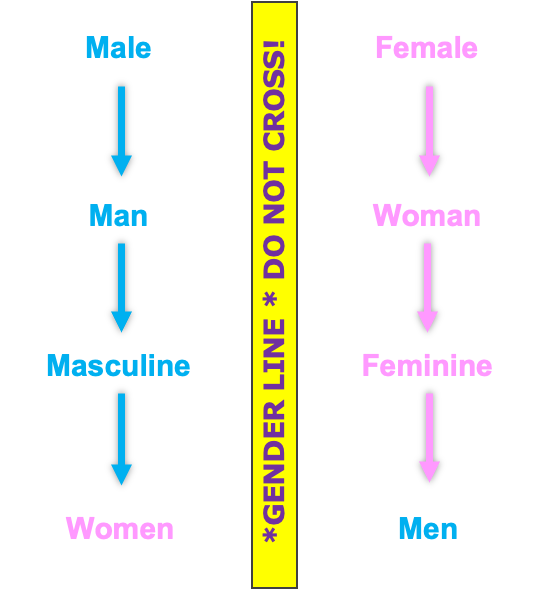
Rather, that is how many societies, including patriarchal, Christian nationalist, and White supremacist ones, want things to be.
So whenever people do cross the “GENDER LINE: DO NOT CROSS”—and they do often—they get “corrected” in some way: teased, bullied, attacked, stigmatized, discriminated against, criminalized, etc. It can be anything from a sideways glance at a masculine-presenting woman in the grocery store to namecalling a effeminiate boy on the playground to jailing or killing men who have sex with men.
In these contexts, people who are genderqueer, trans, nonbinary, gay, bisexual, etc., learn at young ages that those parts of them are wrong, bad, unacceptable. I’ve recently read David Archuleta’s autobiography, Devout, where he felt attraction to both girls and boys at age five or so, but quickly learned that attraction to girls was expected, wanted, celebrated, and attraction to boys was sinful, ugly, and to be hidden. This morning, I’ve been reading Janet Mock’s book, Redefining Realness. She was raised as a boy, and has similar experiences where others teased, mocked, and disciplined her anytime she acted too girly or indicated attraction to boys.
Janet and David deeply internalized that stigma and carried that shame into adulthood. That is the legacy of the essentialist binary gender model; loathing and self-loathing for anyone who doesn’t fit into the neat, socially-constructed, either/or boxes.
This is also where the idea comes from that crossing that Gender Line—whether through gender identity (who we are regarding gender), gender expression (how we dress and accessorize, and how we talk, walk, and hold our arms, etc.), or sexual orientation (which gender[s] we are attracted to)—is deviant, wrong, or pathological, or caused by trauma.
That pathology theory says that the gayness/transness itself is an illness and leads to worse mental and physical health. And it is true that sexual and gender minorities (e.g., LGBTQ people) as a group deal with more anxiety, depression, suicidality, STDs, etc.
This point of view leads to questions like, “Why would you choose to be trans if it causes depression?” (My brother asked me this.)
Within these lines: content warning for sexual abuse of children
An old, discredited theory (that certain powers that be still espouse) posits that gay/transness is caused by sexual abuse in childhood. To take David and Janet’s stories again, both had parents or others suspect or ask them if sexual abuse or molestation in childhood caused their gayness (for David) or transness (for Janet). In David’s case, he denies being molested (though he shares openly about another family member who was—and is straight) and reassures his mom that, no, being gay is not caused by trauma.
In Janet’s story, she was molested by a teenage step-brother daily when she was eight to ten years old. She knows, however, that she saw herself as a girl long before that happened. She explains—and I agree with her—that predators often target people who are perceived as different. In her case, for being effeminate. So being abused doesn’t cause gayness/transness, but abusers target gay/trans kids, often long before they know what to call their differences.
The pathology theory was the predominant one in medicine, public health, and society at large in the US up through the 1970s, when a newer (much better) theory came into play (the Minority Stress theory, see below).
That means that the vitriol the DefSec is spouting and this administration’s anti-trans Executive Orders are not new at all. They are a return to the past. They ignore the scientific evidence base we built up since the 1980s.
(The early 1900s’ evidence base for trans-related medical care and sociology was housed in the Sexology Institute in Berlin, Germany, until the Nazis destroyed it in 1933, in the first famous book burning of the Hitler regime. Sexual and gender minorities, i.e., LGBTQ people, were targeted and murdered during the Holocaust, too. Further evidence of how the Gender Binary model is a key feature of patriarchy, fascism, and White Supremacy.)
Social Constructionism & Sex/Gender
In social constructionism, sex and gender have no fixed meaning other than their cultural, social meanings. The underlying reality doesn’t always fit our social constructions. For convenience and comprehension, we place people into discrete bins to creative measureable categories. “How many boys and how many girls are in this school?”
But a social constructionist approach disrupts those neat categories and instead focuses on meanings, practices, symbols, and their relationships to institutions and power.1 It says that the sex/gender binaries are relatively new, culturally-bound, Western, and colonially imposed across the world.
Historically and culturally, we have lots of evidence that sex and gender are and were not considered binary, and there was lots of room for alternative gender expression and identities. The link is to an interactive world map with summaries of various genders from every continent (except Antarctica). The book Before We Were Trans by Kit Heyam is another great resource for learning about this historical and global variety.
Like race, the concept of sex—intersex, female, male—is based in biology and physiological characteristics:
external genitalia (vulva, phallus, testicles)
hormones (estrogens, testosterone)
in fetal development
in pubertal development
gonads (ovaries, testes, or a mix of both)
internal reproductive organs (uterus, vagina, prostate, etc.)
chromosomes (XX, XY, XXY, XO, XYY, etc.)
secondary sex characteristics (breasts, facial hair, etc.)
We assign sex based usually exclusively by looking at the external genitalia and determining whether the individual has a vulva or a penis/testicles. See more in my post, “Let’s talk about ‘biological’ sex, baby.”
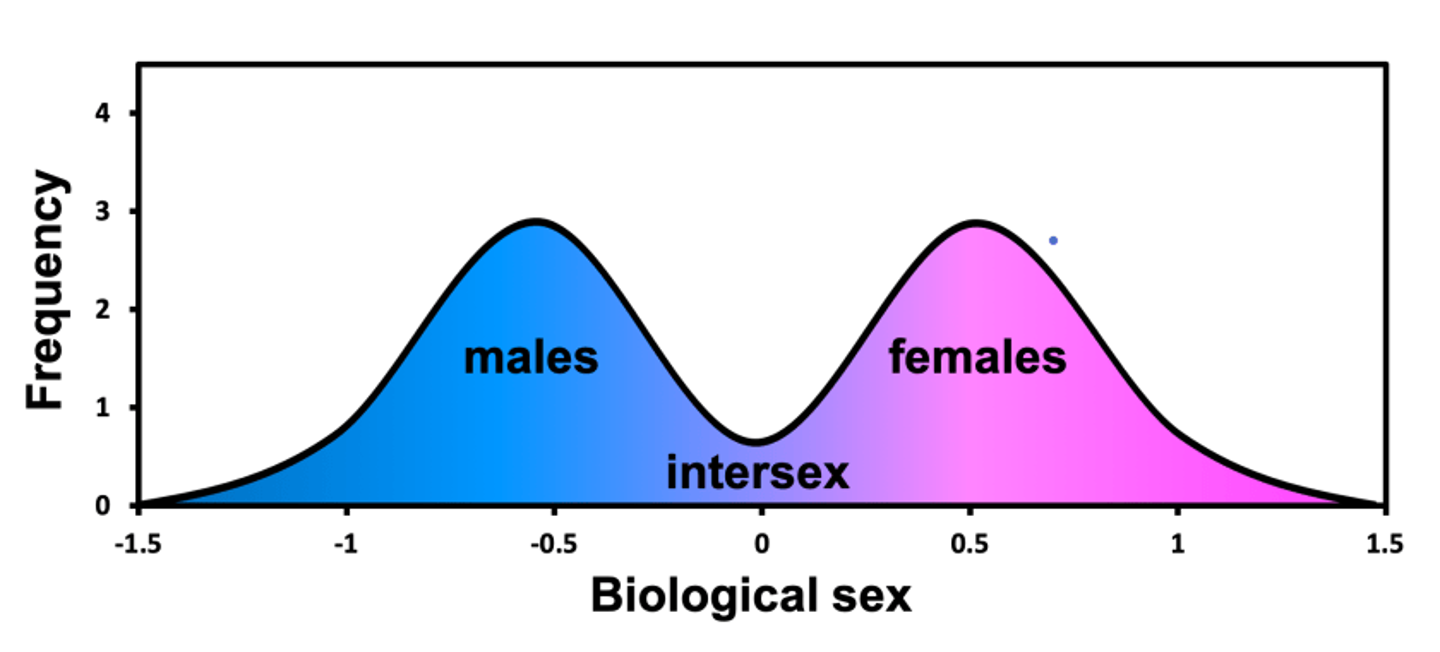
However, intersex people exist, whether they have differences in external genitals, fetal hormones, pubertal hormones, gonads, chromosomes, internal reproductive organs, or secondary sex characteristics.
Where we decide to draw the line to classify an intersex infant as male or female is a social choice. That is, sex is socially constructed, too. (Read anything by Anne Fausto-Sterling for more.)
Using a social constructionist approach, we can further interrogate sex and gender and ask questions like “What does it mean to be a woman?” “What makes a ‘good’ mother?”
When men and boys tell each other, “Act like a man!” or “Be a man!” they are policing the Gender Line (see above), but they are also taking a social constructionist viewpoint—that being a man requires certain behaviors and attitudes, and one can lose the status of “real man.” When they talk this way, they aren’t talking about genitals, chromosomes, or hormones, those biological, physiological markers of maleness. No, they are talking metaphorically; gonads or balls become a symbol for bravery, strength, and manhood itself. (Ironic, since testes are delicate.)
Alternative Theory of LGBTQ Health Disparities
This brings us finally to the alternative explanation for why gayness/transness is associated with worse mental and physical health (on a group level). I’ve already written about the Minority Stress Model.2 It argued that gayness and transness don’t need an explanation or a search for a cause, because there is nothing wrong with it.
Brooks said there is nothing inherently wrong or deviant or ill about being gay (or trans). Instead, the health disparities—the higher depression, anxiety, suicidality, etc.—are because of social stigma and discrimination against being gay (or trans).
If you have a society that affirms, accepts, and celebrates LGBTQ people, those health disparities would not exist. We see this in trans youth whose families fully support and accept them, including helping them access age-appropriate medical care—they have mental health on par with their cisgender peers.
Erase the stigma, and gayness/transness are just a part of the variety of human existence, like hair, skin, and eye color, like personality. Differences that make us unique and beautiful. The spice of life.
And we are worth celebrating.
Note: I owe a lot to Dr. Tonia Poteat for the conceptualization of essentialism vs. social constructionism’s applications to sex and gender.
For more, see 1) Raewyn Connell’s work on Gender and Power; 2) this book chapter: Beyond Binary Sex and Gender Ideology (Abstract: “Perceived as natural and universal, the framing of sex and gender as binaries is in fact a cultural ideology. The empirical reality is that sex is a spectrum, manifesting in a wide array of sex variance, some of it formally categorized as intersex by scientists and doctors, and some not. This article gives an overview of how different societies have organized sex and gender into three, four, or more categories, and of the imposition of binary sex/gender as part of the European colonialist project. It then presents case histories examining four transgender and/or intersex individuals in the contemporary context, illustrating how individuals negotiate, exploit, or subvert binary sex/gender ideologies in conceptualizing physical sex variance and gender transition.”), and 3) this article on scientific challenges to the binary: Hyde JS, Bigler RS, Joel D, Tate CC, van Anders SM. The future of sex and gender in psychology: Five challenges to the gender binary. Am Psychol 2019; 74(2):171-193.
This theory was first applied to sexual minorities in Winn Kelly (né Virginia) Brooks’s master’s thesis, “Minority Stress and Lesbian Women.” See Rich, A. et al. Sexual Minority Stress Theory: Remembering and Honoring the Work of Virginia Brooks (2020). It was further developed and applied to gay men, then all sexual minorities, by Ilan Meyer, and later expanded to gender minorities by Testa.
Thank you for such a comprehensive discussion about this. So desperately needed during a time of so much dis-and-mis-information.
You name something important here: the “lens” we choose isn’t neutral.
Support and affirmation are not abstract ideas — they correlate with better health outcomes, safety, and stability. Pathologizing and erasing do the opposite. That’s not a culture-war talking point; it’s backed by decades of medical and psychological research.
The tree metaphor works because it shows how perspective shapes interpretation. The problem is when certain lenses aren’t just perspectives — they translate into policy that strips trans and nonbinary people of documentation, safety, and legitimacy. That’s not philosophical; it’s material.
And your boundary around trolls makes sense. Not every space is a debate stage. Protecting your energy is not avoidance — it’s sustainability.
The spectrum framing is also key. Human biology, psychology, and identity are more complex than binary shortcuts. Pretending otherwise doesn’t simplify reality; it distorts it.
This kind of writing helps move people who are “in the middle” toward understanding — not by shouting, but by reframing how they see.
That matters.